When it comes to wiring a home or commercial property, two common circuit types are used in the UK radial and ring circuits. Both are designed to deliver electricity safely and efficiently, but they work in different ways and suit different types of installations. Understanding how each circuit operates, along with their pros and cons, can help you choose the right setup for your project.
What is a Ring Circuit?
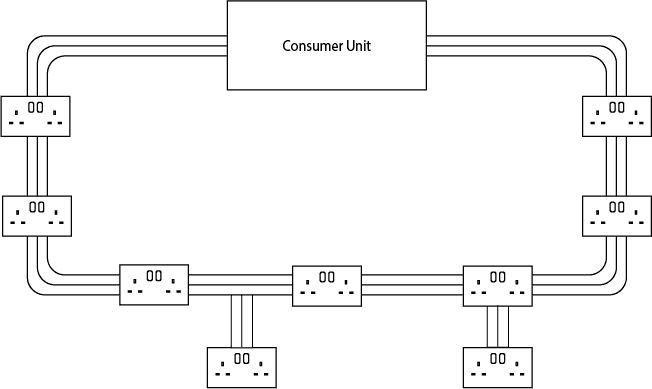
A ring circuit is one of the most common wiring configurations used in UK homes, particularly for socket outlets. As the name suggests, it forms a complete ring or loop that starts and ends at the consumer unit (fuse box).
How a Ring Circuit Works
In a ring circuit, electricity flows through live and neutral conductors in both directions around the loop. This means each socket is supplied by two paths, effectively sharing the electrical load between them. Most domestic ring circuits use 2.5mm² twin and earth cable protected by a 32A circuit breaker, especially when this circuit feeds sockets.
This design makes it possible to power multiple sockets on a single circuit without overloading the wiring. You’ll typically find ring circuits used in living areas, kitchens, and other rooms with several outlets.
Advantages of a Ring Circuit
Ring circuits are highly efficient because current can travel in two directions. This reduces the voltage drop across the circuit and helps prevent cables from overheating. It also allows higher loads to be supplied without increasing cable size, which makes the system cost-effective and practical for most domestic layouts.
Electricians also appreciate that ring circuits make good use of standard cable sizes and provide flexibility when distributing sockets evenly around a room.
Disadvantages of a Ring Circuit
The main drawback of ring circuits is that they can be harder to inspect or modify. If a fault occurs, such as a break in the loop, the circuit can become overloaded on one side without the user realising. This means that testing is really important to confirm continuity and keep it safe.
Extending or altering a ring circuit can also be tricky. Any additions must comply with wiring regulations to avoid creating “spurs on spurs” or exceeding the circuit’s designed capacity.
Ring Circuit FAQs
Can I extend a ring circuit myself?
It’s always safest to have a qualified electrician carry out any circuit extensions. Incorrect wiring can cause faults or safety risks.
What size cable is used in a ring circuit?
Typically, 2.5mm² twin and earth cable is used for sockets, protected by a 32A breaker.
Are ring circuits still used in new builds?
Yes, although some modern installations are now moving towards radial circuits for simplicity and flexibility.
What is a Radial Circuit?
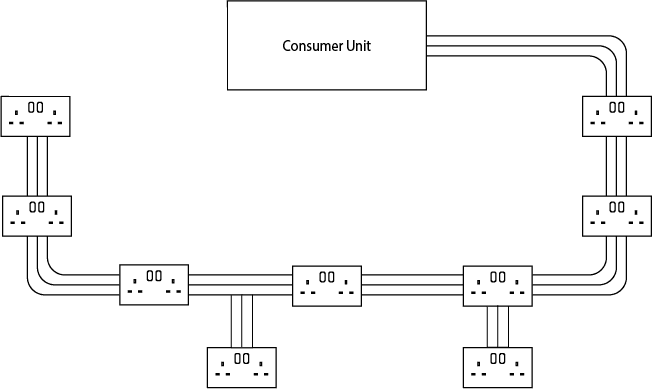
Unlike a ring circuit, a radial circuit doesn’t loop back to the consumer unit. Instead, it runs in a straight line from the consumer unit to each outlet in sequence.
How a Radial Circuit Works
In a radial setup, electricity travels in a single direction from the supply to each connected device. Once it reaches the last socket or appliance, the circuit ends. Radial circuits are often used for smaller installations or specific high-load appliances like ovens, showers, and outdoor sockets.
Cable size and breaker ratings vary depending on the load. For example, a 2.5mm² radial circuit might be protected by a 20A breaker, while a 4mm² circuit could use a 32A breaker.
Advantages of a Radial Circuit
Radial circuits are straightforward to design and install, making them ideal for extensions, garages, and workshops. They’re easier to test and modify, and there’s less chance of confusion if future changes are made.
Their simplicity also makes them popular in commercial and industrial environments where circuits often power specific equipment or zones.
Disadvantages of a Radial Circuit
Because power only flows in one direction, voltage drop can be higher over longer cable runs. This means cable sizes may need to be increased to maintain efficiency and safety. Radial circuits can also handle fewer sockets than an equivalent ring circuit, so more circuits might be required in larger properties.
Radial Circuit FAQs
Can a radial circuit power a kitchen?
Yes, but it must be correctly rated. Kitchens often have high power demands, so a 4mm² cable with a 32A breaker is sometimes used.
What breaker size do I need for a radial circuit?
It depends on the cable size and expected load. Common setups include 20A for 2.5mm² cable or 32A for 4mm² cable.
Are radial circuits safer than ring circuits?
Both can be equally safe when installed correctly. Radial circuits are often considered simpler to test, but safety depends on proper design and adherence to regulations.
Ring Circuit vs Radial Circuit: Which is Better?
There’s no one-size-fits-all answer both have their place. Ring circuits are efficient for powering multiple sockets in domestic settings, while radial circuits offer a simpler layout for specific circuits or smaller installations.
In general:
- Use ring circuits where you need to supply several outlets across a room or floor.
- Use radial circuits for single-purpose runs, outdoor areas, or appliances with higher individual loads.
Your choice will depend on the property layout, total power requirements, and ease of future maintenance.
Choosing the Right Circuit for Your Installation
For homeowners, the best approach is to consult a qualified electrician who can assess your electrical needs. Professionals will consider load diversity, cable runs, and compliance with BS 7671 Wiring Regulations before recommending the most suitable setup.
Electricians designing new installations may prefer radial layouts for their simplicity and scalability, especially in commercial projects. However, ring circuits remain popular in domestic wiring for their efficiency and cost-effectiveness.
Both radial and ring circuits are safe, reliable, and compliant when installed correctly. The key difference lies in how electricity flows and how each configuration handles load. Whether you’re wiring a new build, upgrading a kitchen, or adding an outdoor socket, understanding the distinction helps ensure the right choice for performance, safety, and future flexibility.