When the clocks go back, the evenings close in quickly. By mid-December the sun sets at around 4pm across much of the UK, and earlier still in the north, so many of us leave for work and return home in the dark. That leaves homes and businesses unlit for far longer, and plenty of properties stand empty at exactly those times.
The good news is that a few well chosen products can make a real difference. This guide explains how security lighting, burglar alarms and CCTV work together, and what to look for when choosing each one.
Why winter is the time to review your security
Shorter days mean more hours of darkness at both ends of the working day. Trips away over the festive period can also leave a property empty for days at a time. A quick review now, before the darkest weeks arrive, is far easier than fixing a gap later.
The most reliable approach is to build your security in layers. Lighting helps you see and be seen, an alarm alerts you when something is wrong, and CCTV records what happened. Each layer does a different job, and together they cover each other's weaknesses.
Start with security lighting
Good lighting is the simplest and most affordable place to begin. A bright light that switches on without warning draws attention to anyone approaching your property, and it makes your own doorway and driveway safer to use on dark evenings.
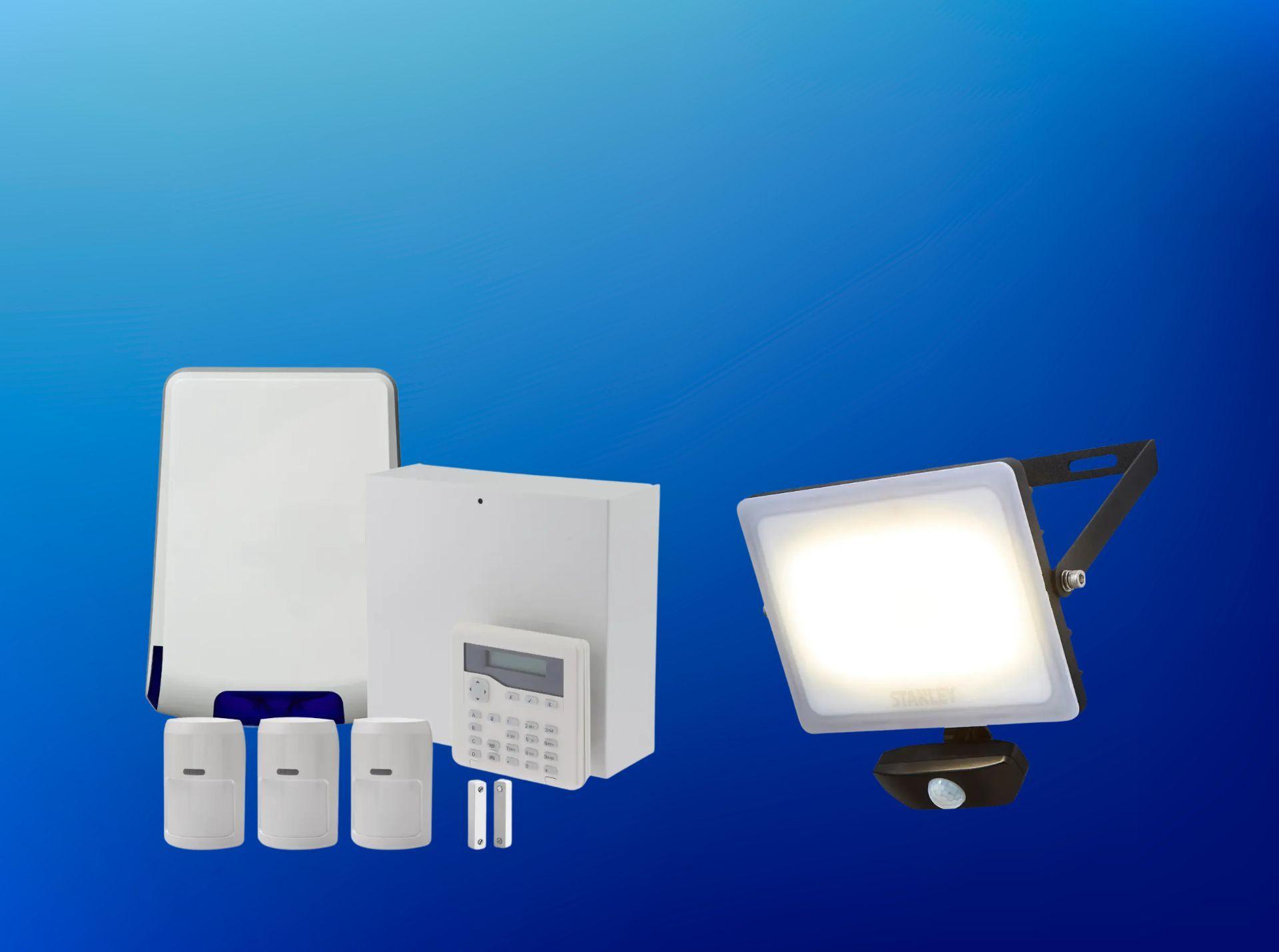
PIR floodlights are the most popular choice. PIR stands for passive infrared, which means the sensor detects movement and body heat. Because the light only comes on when needed, running costs stay low. A 20W LED floodlight, for example, uses one unit of electricity (1kWh) after 50 hours of use, and a PIR light is only on for a fraction of the night.
You can browse the full range of outdoor security lighting, including PIR LED floodlights. A few points will help you choose well.
Match the power to the space. As a rough guide, a compact 10W to 20W LED floodlight suits a front door, side passage or back step. Driveways, yards and larger areas usually need 30W to 50W.
Check the IP rating. IP44 protects against splashing water, which is fine for a sheltered spot. For exposed walls facing wind, rain and frost, choose IP65, which is dust tight and protected against water jets.
Fit and aim it properly. Most PIR lights are designed to be mounted at around 1.8 to 2.5 metres, but always follow the manufacturer's instructions. Angle the light downwards, and use the sensitivity, timer and lux settings if your model has them. This reduces false triggers from passing cats and cars, and avoids shining into your neighbours' windows.
Consider solar carefully. Solar PIR lights need no mains wiring, but shorter days and weaker winter sunlight reduce how much charge they collect. They suit sheds and fence lines better than your main entrance.
Fixed mains wiring outdoors should be carried out by a competent person, such as a qualified electrician.
Add a burglar alarm
Lighting deters, but an alarm tells you when something has actually happened. Alert Electrical stocks burglar alarm systems from established brands including Texecom, Pyronix, Scantronic and Kinetic.
There are three choices worth understanding:
- Wireless or wired. Wireless alarms use battery powered sensors that talk to the control panel by radio, so there are no cables to run around the property. Wired systems connect the sensors and siren directly to the panel, so the sensors do not depend on their own batteries.
- Bell only or dialler. A bell only alarm sounds a siren and relies on someone nearby noticing it. A dialler alarm also calls a nominated phone number when it triggers, which is useful when you are out or away.
- Kit or separate parts. If you are starting from scratch, a complete burglar and intruder alarm system gives you the panel and the core devices in one purchase.
A winter tip for wireless systems: cold weather can shorten battery life. Check your panel for low battery warnings and test the system before you go away for Christmas.
Use CCTV to see what happens after dark
CCTV gives you a record of events and, with the right system, a live view on your phone. In winter, night performance matters more than ever, so look for infrared night vision and a resolution that captures useful detail. Higher resolution cameras, such as 4MP models, show more detail than 2MP cameras, which helps when you need to identify a person or a vehicle.
Our CCTV buying guide explains the difference between analogue and IP cameras, and you can view the analogue CCTV systems we stock.
A few practical winter points:
- Watch for infrared glare. Infrared light can bounce off raindrops, snowflakes and cobwebs close to the lens, which can wash out the image. Mounting cameras under eaves and keeping lenses clean helps.
- Avoid pointing cameras at bright lights. A floodlight shining straight into a lens can spoil the picture. Position them so the two work side by side.
- Think about privacy. If your cameras capture public spaces or your neighbours' property, data protection law applies, so aim cameras at your own property where possible. The Information Commissioner's Office publishes guidance for domestic CCTV users.
A simple winter security checklist
- Test outdoor lights and replace any that are faulty.
- Adjust PIR sensors so they cover paths, doors and side access, and clear any overgrown plants blocking the sensor.
- Check alarm batteries and run a full system test.
- Clean CCTV lenses and review night time footage for glare.
- Set up timers or lights for the evenings you are away, so the property does not look empty.
Frequently asked questions
Do PIR floodlights use a lot of electricity?
No. LED PIR floodlights only switch on when they detect movement, so they run for a small part of the night. A 20W LED floodlight uses 1kWh after 50 hours of use, so even regular activations add very little to your bill.
How high should I fit a PIR floodlight?
Most are designed to be fitted at around 1.8 to 2.5 metres, but the correct height and detection range depend on the model. Follow the manufacturer's instructions and test the coverage at night before you finish the installation.
Is a wireless or wired burglar alarm better?
Neither is better in every case. Wireless systems are quicker to fit because there are no cables to run, while wired systems have sensors that do not rely on their own batteries. Your choice will depend on the property, your budget and how much installation work you are comfortable with.
Can I install outdoor security lighting myself?
Battery and solar powered lights can usually be fitted without any mains work. Fixed mains wiring outdoors should be done by a competent person, such as a qualified electrician, to keep the installation safe and compliant.
Be ready before the darkest weeks
Dark winter evenings do not have to mean a less secure home. Start with bright, well placed PIR lighting, add an alarm that suits your property, and consider CCTV for a clear record of what happens after dark.
Explore the full range at Alert Electrical to find the right combination for your home or business.