A well-lit garden does more than make your property look good after dark. It extends your usable outdoor space, deters opportunistic intruders, highlights the features you've spent time and money creating, and makes paths and steps safer to navigate. Yet for most people, outdoor lighting gets added as an afterthought — a single wall light above the back door and not much else.
This guide covers everything you need to know to plan a garden lighting scheme properly: the different types of fitting available, where to use them, what IP ratings mean in practice, how colour temperature affects atmosphere, and when you need a qualified electrician rather than a plug socket.
Start with a plan, not a product
Before you buy anything, walk around your garden at night and think about what you actually want your lighting to do. Most garden lighting schemes serve at least one of three purposes:
Ambient lighting — a general, soft level of illumination that lets you enjoy the garden after dark without harsh glare.
Task lighting — brighter, more directional light for paths, steps, and outdoor cooking or dining areas.
Accent lighting — focused beams used to highlight a specific tree, statue, water feature, or architectural detail.
A good scheme usually layers all three. You start with the ambient base, add task lighting where safety or usability demands it, and then use accent lighting to give the garden depth and character after dark.
Sketch your garden roughly on paper and mark the features you want to illuminate, the routes people walk regularly, and any areas you use for outdoor entertaining. This shapes both the types of fitting you need and where they go.
Understanding IP ratings for outdoor lighting
IP stands for Ingress Protection. Every fitting designed for outdoor use carries an IP rating — two digits that tell you how well the fitting resists solid particles (the first digit) and water (the second).
For garden use, the ratings you'll encounter most often are:
- IP44 — protected against objects larger than 1mm and against water splashed from any direction. Suitable for covered outdoor areas like porches, car ports, and pergolas where the fitting isn't directly exposed to rain.
- IP54 — dust-protected (not fully sealed) and splash-proof. A step up from IP44 and fine for most partially exposed positions.
- IP65 — fully dust-tight and protected against low-pressure water jets from any direction. The standard for most open garden positions — wall lights, bollards, and floodlights that will be rained on directly.
- IP67 — fully dust-tight and can withstand temporary immersion in water up to 1 metre deep for 30 minutes. Required for ground-recessed lights set into decking, paving, or lawn areas where water may pool.
- IP68 — dust-tight and suitable for continuous submersion. Used for pond and water feature lighting.
As a rule, if a fitting will be exposed to direct rainfall, IP65 is the minimum you should consider. For anything set into the ground or near water, IP67 or higher is required.
Types of outdoor lighting and where to use them
Wall lights
Wall lights are the most versatile fitting in any garden scheme. They mount flush to an exterior wall and provide both functional illumination and a decorative element to the facade of your home. Most are wired directly into your mains circuit, which means a qualified electrician needs to install them. Alert Electrical's outdoor lighting range includes wall lights from brands including Forum Lighting, Lutec, Ansell, Knightsbridge, Konstsmide, and Saxby — in styles ranging from traditional lantern designs to clean, architectural up-down fittings.
Wall lights work well flanking a front door, positioned either side of a garage entrance, or mounted at intervals along a long garden wall or fence to create a rhythm of light. Up-and-down wall lights are particularly effective on rendered walls, where the light washes upward and downward to create interesting shadow and texture.
When positioning wall lights on an exterior wall, think about height. Too low and they create glare at eye level. A height of around 2 to 2.5 metres is generally a good starting point for a standard residential property.
Outdoor lanterns
Lantern-style fittings have been used at the entrance to homes for centuries, and they remain the most popular choice for front door and porch positions. Outdoor lanterns are available in traditional black cast aluminium, brushed steel, antique bronze, and contemporary matt finishes to suit a wide range of property styles.
PIR (passive infrared) lanterns add a motion sensor into the fitting itself, so the light activates when someone approaches and turns off after a set period. This is a practical choice for front doors, side gates, and driveways where you want security coverage without leaving a light on permanently.
Security floodlights
Floodlights provide the highest lumen output of any garden fitting and are designed to flood a wide area with light. LED floodlights have largely replaced halogen models in recent years and consume significantly less energy for an equivalent light output. A typical LED floodlight will use around 20–50W to produce the output that previously required a 150–500W halogen.
Floodlights with PIR sensors are effective security deterrents. The sudden illumination when triggered tends to deter casual opportunists and draws attention to movement on your property. Position them to cover your most vulnerable access points — the side passage, the rear garden gate, and any area that isn't visible from a neighbouring property or the street.
When choosing a floodlight, pay attention to beam angle as well as wattage. A narrow beam concentrates light in one direction; a wide beam covers a broader area but at lower intensity. For most garden security applications, a beam angle of 100–120 degrees provides a good balance. Most floodlights rated IP65 are suitable for permanent outdoor installation.
Garden and spike lights
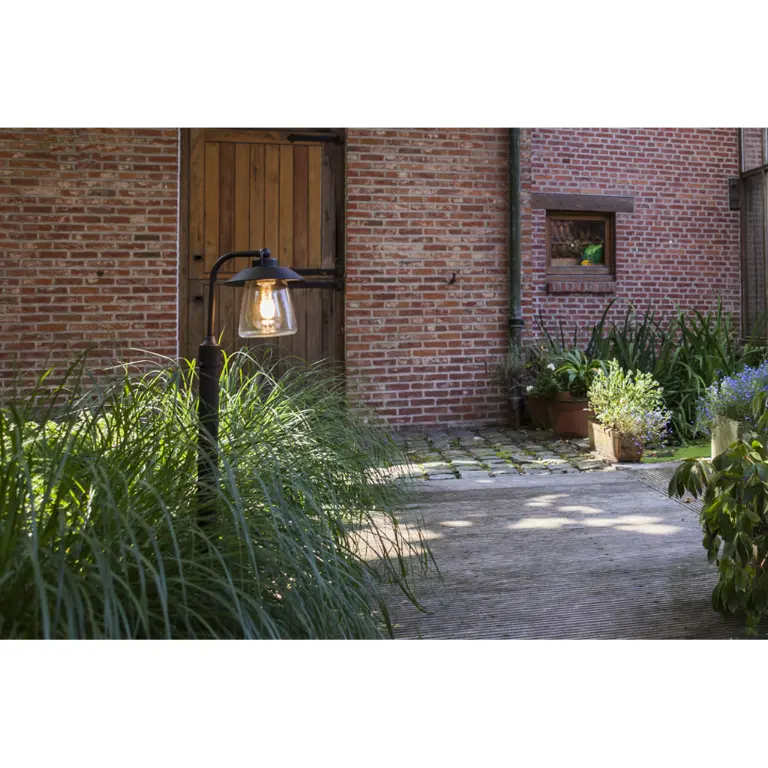
Spike lights are self-contained fittings mounted on a ground spike, pushed directly into a flower bed or lawn. They're used to uplight trees, shrubs, and architectural features, or to mark out the edges of a path. Because they're positioned in the garden rather than on a structure, they need a higher IP rating — IP65 as a minimum for most applications.
Explore the garden lighting category for spike lights, bollards, and post lights from Lutec, Konstsmide, Forum Lighting, Knightsbridge, and Saxby.
Bollard lights
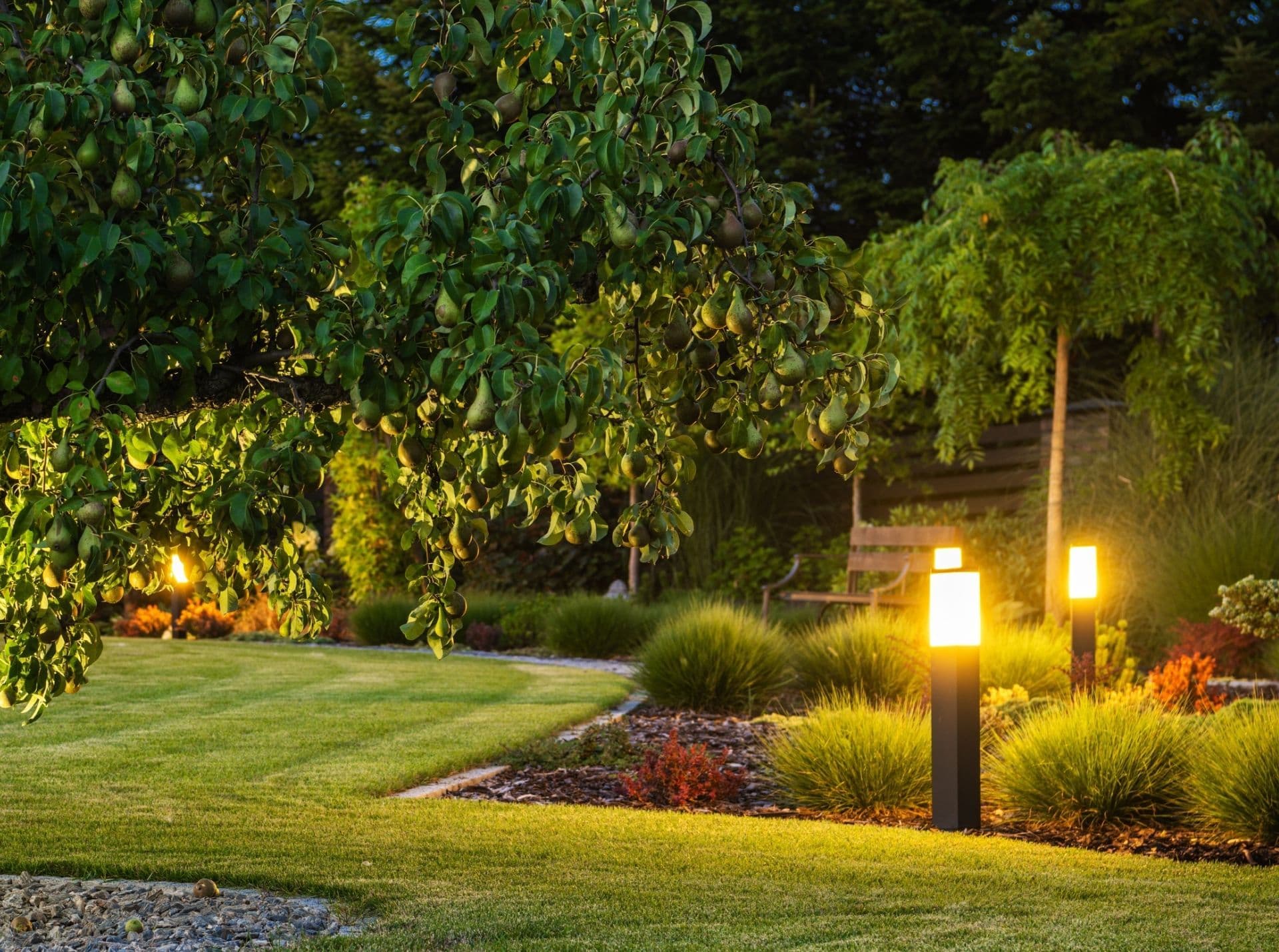
Bollard lights are freestanding posts, typically 600mm to 1200mm in height, that provide low-level directional lighting for paths, driveways, and garden borders. They're more robust than spike lights and can be set into a concrete base for permanence. Bollards work well in contemporary schemes where clean lines and a considered aesthetic matter.
Because bollards sit close to the ground, they don't create the upward glare that affects neighbours or contributes to light pollution — a consideration worth bearing in mind in residential areas.
Low-level and recessed lighting
Ground-recessed lights are flush-mounted into paving, decking, or steps and provide subtle accent lighting with no visible hardware above the surface. They're particularly effective for lighting up steps and changes of level (an important safety consideration), for running light along the edge of a driveway, or for uplighting a planted border from directly below.
Because they're set into the ground, recessed fittings must carry an IP67 rating as a minimum. Low-level exterior lighting from brands including Ansell, Aurora, Saxby, and Endon are available in LED formats that are energy efficient and long-lasting.
Festoon lights
Festoon lights are strings of evenly spaced bulbs on a flexible cable, used to create atmosphere in outdoor entertaining spaces. They're increasingly popular for gardens, patios, pergolas, and events — delivering a warm, social quality of light that other fitting types can't quite replicate. Festoon lights designed for outdoor use typically carry an IP44 or IP65 rating and use LED bulbs for energy efficiency and longevity.
Festoon strings are most commonly run between two fixing points — along a fence, between posts, or draped through a pergola frame. They're plug-and-play in most cases, although a permanently installed supply with a weatherproof outdoor socket makes a tidier job and removes a trailing cable from a high-traffic area.
Solar garden lights
Solar lights are powered by an integrated photovoltaic panel that charges a battery during daylight, then discharges it after dark. They require no wiring and can be repositioned freely, making them a popular first step into garden lighting for many homeowners. Solar garden lights range from simple path markers to solar-powered wall lanterns and bollards.
The practical limitation of solar lights is their dependency on available sunlight. During a UK winter, shorter days and lower sun angle mean reduced charging time and a shorter output period each night. For this reason, solar lights are best suited to accent and path marking applications rather than security or task lighting, where consistent output through the night is important.
For security and task positions, a mains-wired LED fitting with a PIR sensor or timer will deliver more reliable performance year-round.
Colour temperature: getting the mood right
Colour temperature is measured in Kelvin (K) and describes the tone of the light a fitting produces. Lower Kelvin values produce warm, amber-tinted light; higher values produce cool, blue-tinted light. In a garden context, colour temperature has a significant impact on both the atmosphere you create and how plants and materials appear after dark.
The main ranges relevant to garden lighting are:
- 2700K (warm white) — the warmest commonly available tone, closely resembling traditional incandescent or filament bulb light. Ideal for entertaining areas, patios, and decking where you want a relaxed, social atmosphere. Flattering to skin tones and particularly effective on warm-coloured materials like brick, timber, and sandstone.
- 3000K (warm white to neutral white) — slightly crisper than 2700K but still in the warm range. A versatile choice that suits both contemporary and traditional schemes. Works well for path lighting and for uplighting trees and shrubs, where it produces accurate-looking greens without the artificiality of a cooler tone.
- 4000K (cool white/neutral) — noticeably cooler and more clinical. Appropriate for security floodlights and task lighting where maximum visibility is the priority rather than atmosphere. Less suitable for entertaining areas.
As a general guide, keep your main garden scheme in the 2700K to 3000K range for a warm, cohesive result. Save cooler temperatures for purely functional positions. Mixing colour temperatures across a single garden can create a visually jarring effect, so aim for consistency wherever possible.
Planning placement: key areas to consider
Paths and steps
Safety should drive lighting decisions on paths and steps. Any change of level should be lit so it's visible in darkness. Low bollards, recessed step lights, or spike fittings placed at the edge of a path provide enough illumination for safe navigation without creating glare. Aim for even light distribution rather than pools of bright light alternating with dark sections.
The front door and entrance
The entrance to your home is the most important position in any outdoor lighting scheme. A well-lit entrance makes the property look welcoming, helps visitors and residents identify the door and find keys, and deters opportunistic crime. A wall lantern or pair of wall lights flanking the door, ideally with a PIR sensor, covers most requirements. If you have a longer driveway or path, additional lighting along the route to the door is worth considering.
Seating and entertaining areas
Outdoor dining and seating areas benefit from warm, relatively low-level lighting that creates atmosphere without overwhelming conversation. Festoon lights overhead, wall lights at the perimeter, and candle-style lanterns at table level work together to create a layered effect. Avoid positioning a bright security floodlight directly above an entertaining area — the output is too harsh for social use.
Trees, shrubs, and water features
Uplighting a tree or specimen shrub with a spike-mounted spotlight transforms a garden after dark and creates strong visual interest from inside the house. Aim the beam at the trunk and lower canopy rather than straight up through the leaves. For water features and ponds, submersible or near-water rated fittings (IP67 or IP68) that produce a warm glow beneath the surface are far more effective than overhead lighting that simply reflects glare off the water.
Boundaries and outbuildings
Perimeter walls, fences, and outbuildings are common blind spots in home security. A PIR floodlight covering a rear gate, side passage, or the approach to a garage can make a significant difference. Position the sensor so it covers the approach route rather than a narrow field directly in front of the fitting.
Mains wired versus plug-in: what you need to know
Outdoor electrical installations in the UK are governed by Part P of the Building Regulations and must comply with BS 7671 (the IET Wiring Regulations, 18th Edition). Any new circuit supplying outdoor lighting needs to be designed, installed, and certified by a qualified electrician — specifically someone registered with a competent person scheme such as NICEIC or NAPIT.
What this means in practice: if you're running new cable from your consumer unit to exterior fittings, you need a qualified electrician. You cannot legally self-certify this work yourself unless you hold the relevant qualifications.
Plug-in festoon lights and solar fittings don't require a new circuit and can be installed without specialist involvement, provided they're used with appropriate outdoor-rated weatherproof sockets. If you don't have an outdoor socket, having one installed by an electrician is a relatively low-cost job and gives you flexibility for future additions.
Low-voltage garden lighting systems — typically running at 12V via a transformer — sit in a middle ground. The transformer itself needs to be connected to a mains supply, but the low-voltage side of the system is safe to install yourself in most cases. Always check the manufacturer's guidance before proceeding.
Reducing light pollution and energy use
Good garden lighting doesn't mean more light — it means the right light in the right places. Over-illuminated gardens suffer from light scatter that bleaches out the stars, disturbs nocturnal wildlife, and can cause nuisance to neighbours. A few simple principles keep your scheme effective without unnecessary waste:
Direct light downward wherever possible. Bollards and recessed ground fittings direct light toward the ground rather than upward into the sky.
Use PIR sensors and timers. Lights that run only when needed consume a fraction of the energy of continuously operated fittings, and a timer prevents security lights burning through the night unnecessarily.
Choose LED throughout. LED fittings are the standard for energy efficiency. They produce the same or greater light output as traditional halogen or incandescent alternatives at a fraction of the running cost, and with a much longer service life — typically 25,000 hours or more.
Match lumen output to the task. Paths and borders don't need floodlight-level brightness. A fitting producing 200–400 lumens is sufficient for most pathway and accent applications; reserve higher-output fittings for the areas that genuinely need them.
Where to find outdoor lighting at Alert Electrical
Alert Electrical stocks a wide range of outdoor and garden lighting for both residential and commercial applications, from established manufacturers including Forum Lighting, Lutec, Ansell, Konstsmide, Knightsbridge, Saxby, and Endon.
Whether you're after a traditional front-door lantern, a contemporary LED floodlight, or festoon strings for a summer garden party, the full range is available online with free UK delivery.
Browse the full outdoor lighting range at Alert Electrical or explore specific categories:
Garden lighting — bollards, spike lights, solar and post lights
Outdoor lanterns — traditional and contemporary styles
LED floodlights and security lighting
Festoon lights for patios and entertaining spaces
Low-level and recessed exterior lighting