If you've ever opened your consumer unit and stared at a row of switches wondering what on earth they all do, you're in good company. RCD, MCB, RCBO... it's practically alphabet soup. But once you know what each one does, it's actually pretty straightforward, and understanding the difference matters. These protective devices help reduce the risk of electrical fires, damage to wiring and, where residual current protection is provided, serious electric shock.
In this guide, we'll break down exactly what RCDs, MCBs and RCBOs do, how they differ, and what type of protection may be required in a home or business.
What is an MCB?
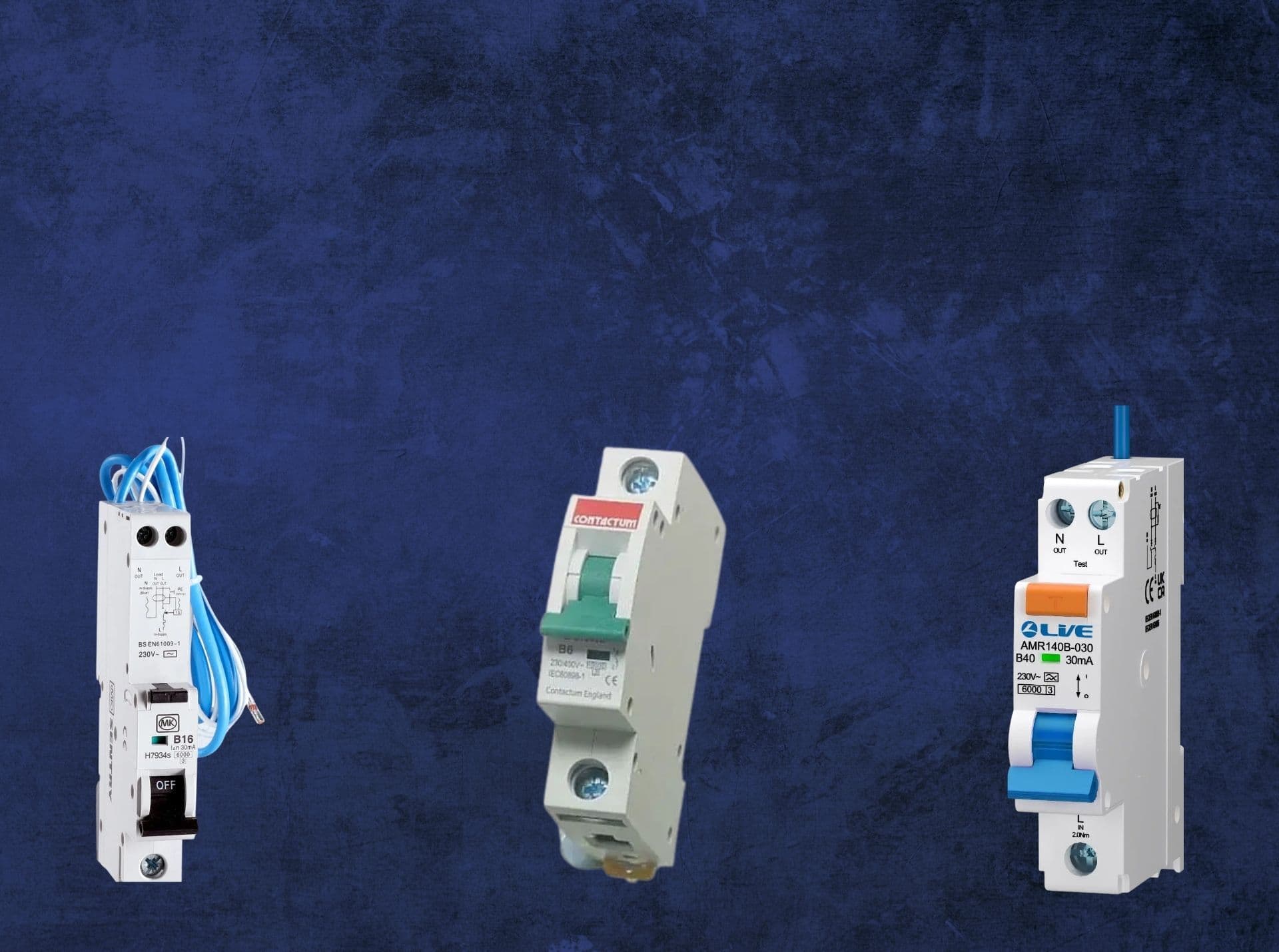
An MCB (Miniature Circuit Breaker) protects a circuit against overcurrent caused by overloads and short circuits. Think of it as the modern alternative to a traditional rewireable fuse. If excessive current flows, the MCB automatically disconnects the circuit before the wiring is exposed to damaging levels of heat.
MCBs are available in different current ratings, with common ratings including 6A, 10A, 16A, 20A and 32A, depending on the circuit and its design. They also have different tripping characteristics. Type B devices are widely used in domestic and similar installations, while Type C and Type D devices may be appropriate where equipment has higher starting or inrush currents. The correct device must always be selected to suit the circuit, load, cable and installation conditions.
In a typical consumer unit, individual final circuits such as lighting, sockets, cookers and showers have their own overcurrent protection. This helps isolate a fault to the affected circuit rather than disconnecting the whole installation.
What an MCB won't do: an MCB is not designed to provide the 30mA additional protection against electric shock that an RCD or RCBO can provide.
Browse our full range of MCB switches for consumer units from trusted brands.
What is an RCD?
An RCD (Residual Current Device) has a different role. In a single-phase circuit, it monitors the current flowing in the live conductor and compares it with the current returning through the neutral conductor. Under normal conditions these currents should be balanced. If some current flows by an unintended path, such as to earth, the RCD detects the imbalance and disconnects the supply.
This residual current can be caused by damaged wiring, faulty equipment or contact with a live part. Where BS 7671 requires additional protection, a device with a rated residual operating current not exceeding 30mA is commonly used. A 30mA RCD is designed to disconnect rapidly when the relevant residual-current and time thresholds are reached, reducing the risk of serious electric shock. It should not, however, be described as making contact with electricity safe.
RCD protection is required in many situations under the current UK Wiring Regulations, including for socket-outlets rated up to 32A, mobile equipment up to 32A for outdoor use, many concealed cables, domestic lighting circuits and circuits in locations containing a bath or shower, subject to the detailed requirements and permitted exceptions within BS 7671.
What a standard RCCB won't do: an RCCB provides residual-current protection but does not provide overcurrent protection against overload or short circuit. Separate overcurrent protection is therefore required.
We stock RCD protected sockets for applications where an RCD-protected outlet is appropriate. Product selection and installation must comply with BS 7671 and the manufacturer's instructions.
What is an RCBO?
An RCBO is a residual current operated circuit-breaker with integral overcurrent protection. In practical terms, it combines residual-current protection with protection against overload and short circuit in a single device.
RCBOs are widely used in modern consumer units because they can provide individual residual-current and overcurrent protection for each circuit. Compared with arrangements where several circuits share one RCD, this can reduce unwanted disruption: a fault on one RCBO-protected circuit will normally disconnect that circuit without unnecessarily switching off other healthy circuits.
This also makes fault finding easier and helps designers meet the BS 7671 requirement to take account of the consequences of unwanted tripping. The exact consumer unit arrangement still needs to be designed for the installation rather than assuming that one configuration is suitable in every case.
Explore our range of RCBOs from major circuit protection brands.
RCD vs MCB vs RCBO: the key differences at a glance
MCB (Miniature Circuit Breaker)
- Protects against: Overloads and short circuits
- Additional 30mA shock protection: No
- Overcurrent protection: Yes
RCCB / RCD Protection Device
- Protects against: Residual current / earth leakage
- Additional 30mA shock protection: Yes, when correctly selected
- Overcurrent protection: No
RCBO (Residual Current Breaker with Overcurrent Protection)
- Protects against: Residual current / earth leakage, overloads and short circuits
- Additional 30mA shock protection: Yes, when correctly selected
- Overcurrent protection: Yes
The short version: MCBs provide overcurrent protection, RCDs provide residual-current protection, and RCBOs combine both functions in one device.
Which one do you actually need?
For new domestic installations and consumer unit replacements, BS 7671 requires RCD additional protection across many circuits. A main switch consumer unit with individual RCBOs is a common modern design because it limits the number of circuits affected by a residual-current fault. However, BS 7671 does not simply state that every domestic circuit must use its own RCBO, and other compliant arrangements are possible when they are properly designed.
Many older installations use split-load arrangements in which one or more RCDs protect groups of MCBs. The presence of an older arrangement does not, by itself, mean that an installation is unsafe or automatically requires replacement. Its condition, protective measures and compliance for any new work should be assessed by a competent electrician. When a consumer unit is replaced, the new work must meet the applicable requirements of the current edition of BS 7671.
If you're unsure what your current setup includes or whether it needs upgrading, ask a qualified electrician to inspect it. Circuit protection has to be selected to suit factors such as the circuit design, earthing arrangement, cable size, load characteristics and manufacturer's requirements.
Electricians and competent installers can browse our full range of consumer units and circuit protection to find suitable equipment for the installation.
Signs your circuit protection might need attention
Your consumer unit has rewireable fuses or other visibly dated equipment. Age alone does not prove that an installation is unsafe, but it can be a good reason to arrange an inspection.
An RCD or RCBO trips repeatedly with no obvious cause.
You've had an extension, new kitchen, outbuilding or other significant electrical work and are unsure whether the existing consumer unit and protective devices were assessed.
Your installation appears to lack RCD protection on circuits for which modern standards would normally require it. This does not automatically mean an older installation is unsafe, but it is worth having the installation assessed.
Do not remove consumer unit covers or attempt live electrical work to investigate these issues. Alterations to circuit protection should be designed, installed, tested and certified by someone with the necessary electrical competence, with Building Regulations requirements followed where applicable.
Circuit Protection FAQs
Can I fit an RCBO myself?
Work inside a consumer unit is not a suitable DIY task unless you have the necessary electrical competence, test equipment and knowledge of the relevant regulations. In England, replacing a consumer unit is notifiable work under Part P of the Building Regulations. Using a registered competent person is usually the simplest route because they can self-certify qualifying work; otherwise the appropriate Building Control procedure may be required. Requirements differ across the UK.
Why does my RCD keep tripping?
Possible causes include a faulty appliance, moisture in outdoor equipment, damaged wiring or the combined leakage current from several items of equipment. You can switch off or unplug portable appliances to see whether an obvious appliance is associated with the problem, but persistent or unexplained tripping should be investigated by a competent electrician rather than repeatedly reset.
Do I need an RCD on every circuit?
BS 7671 requires 30mA additional protection in many situations, and most circuits in a modern domestic installation will require RCD protection for one reason or another. Examples include socket-outlets up to 32A, domestic lighting circuits, circuits in bathrooms and many cables concealed in walls. The exact requirements depend on the circuit and installation, so it is more accurate to assess each circuit against BS 7671 than to apply a blanket rule.
What's the difference between an RCD and an RCCB?
RCD is the generic term for a residual current device. An RCCB is a specific type of RCD that provides residual-current protection but does not include integral overcurrent protection. An RCBO is also a type of RCD, but it additionally provides overcurrent protection.
Final thoughts
RCDs, MCBs and RCBOs each play an important role in electrical safety, but they do different jobs. MCBs protect circuits against overcurrent, RCDs detect residual current, and RCBOs combine both forms of protection. The right arrangement depends on the installation and should always be selected in accordance with BS 7671 and the equipment manufacturer's instructions.
Whether you're planning a consumer unit installation or sourcing a replacement protective device, browse our circuit protection range for trusted brands, competitive pricing and fast UK delivery. If you're unsure which product is compatible with your consumer unit or application, contact our team for product guidance. Electrical design and installation advice should be obtained from a suitably qualified electrician.