You've probably experienced PIR lighting hundreds of times without giving it much thought. Walk towards a front door, along a driveway or into a garden at night and suddenly a light switches on.
There's no switch to press and no app to open. A PIR sensor has detected movement and automatically activated the light.
PIR lighting can make outdoor areas safer and more convenient. It can also improve home security and reduce the amount of time your outdoor lights are left switched on unnecessarily.
But what exactly is a PIR sensor? How does it detect movement? And why does your security light sometimes come on when nobody appears to be there?
Here's everything you need to know.
What is a PIR sensor?
PIR stands for Passive Infrared.
A PIR sensor detects changes in the infrared radiation within its field of view. People and animals give off infrared radiation as heat. When a warm body moves across the areas monitored by the sensor, the change can trigger the connected light.
The word passive is important. A PIR sensor doesn't send out a signal and wait for it to bounce back. Instead, it monitors the infrared energy reaching the sensor.
This makes PIR sensors particularly useful for automatic lighting.
You'll commonly find them on:
- Outdoor wall lights
- Security lights
- LED floodlights
- Driveway lighting
- Entrance lighting
- Indoor occupancy and motion-controlled lighting
Alert Electrical stocks a wide range of security lighting, including outdoor lights with built-in PIR sensors for homes and commercial properties.
How does a PIR light work?
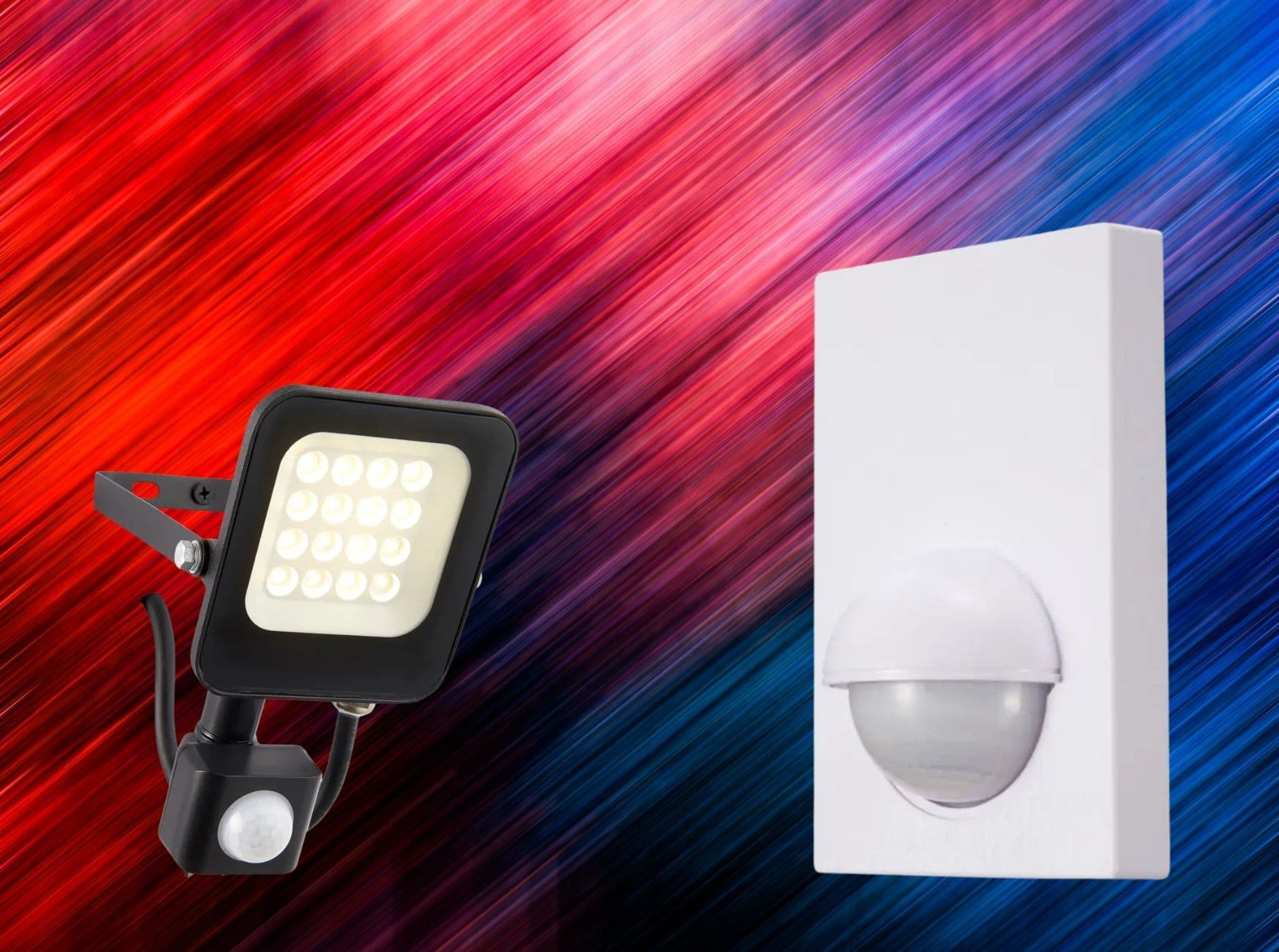
A PIR light combines a lighting fixture with a PIR motion sensor.
When the sensor detects a sufficient change in infrared energy within its detection area, it activates the light. The light then remains on for a set period before switching off again if no further movement is detected.
Many PIR lights allow you to adjust how they operate.
Depending on the model, this can include the detection range, sensitivity, light level and the amount of time the light remains illuminated.
This allows you to set up the light to suit its location rather than having it activate every time something moves somewhere nearby.
How far can a PIR sensor detect movement?
There's no single detection distance for every PIR sensor.
The range depends on the particular product, sensor design, installation height, positioning and surrounding environment.
For example, some outdoor PIR wall lights sold by Alert Electrical have detection ranges of around 7 metres, while other models can detect movement from approximately 8 metres away.
Always check the specifications of the individual light rather than assuming every PIR sensor has the same range.
The detection angle matters too.
A PIR light might have a detection angle of 110°, 120° or another specified angle. A wider angle allows the sensor to monitor a broader area.
Think about both measurements when choosing your light.
For a narrow side entrance, you may not need a particularly wide detection area. For a driveway or larger garden, a broader detection zone could be much more useful.
Browse Alert Electrical's complete outdoor lighting range to compare different lighting options for gardens, entrances, driveways and exterior walls.
Where should a PIR light be positioned?
Positioning can make a huge difference to how well a PIR sensor performs.
The ideal location depends on the property and the sensor's specifications, but you generally want people to move across the sensor's field of view rather than directly towards it.
Think carefully about what you actually want the light to detect.
For example, a PIR light beside your front door could illuminate the entrance when someone approaches. A driveway light might need to cover the route between the pavement and your home.
Try to avoid pointing the sensor towards areas where irrelevant movement is likely to trigger it.
These could include:
- A busy pavement or road
- Trees and bushes that move in the wind
- Areas regularly used by animals
- Sources of heat
- Neighbouring properties or pathways
Correct positioning can reduce false activations while making sure the light still switches on when you need it.
What does the sensitivity setting on a PIR light do?
If your PIR light includes adjustable sensitivity, this controls how readily the sensor responds to changes within its detection area.
A very sensitive setting may increase the likelihood of the light reacting to smaller changes or movement. Reducing the sensitivity can sometimes help if the light is being activated too frequently.
However, turning it down too far could mean genuine movement isn't detected as reliably.
The best approach is usually to start with the manufacturer's recommended settings and make small adjustments if necessary.
Give the sensor time to test each change before adjusting it again.
What does the timer on a PIR light do?
The timer controls how long the light stays on after movement has been detected.
This varies considerably between products.
Some PIR lights may allow you to choose anything from a few seconds to several minutes. For example, selected PIR wall lights available from Alert Electrical offer adjustable timers from around 10 seconds up to 12 minutes.
A shorter timer can be useful for areas where you simply need brief illumination as someone passes.
A longer setting may be better for a driveway, entrance or patio where you want the area to remain lit while it's being used.
Setting an unnecessarily long timer can waste electricity, so it's worth choosing a duration that suits the space.
Why does my PIR light keep coming on?
This is one of the most common questions about PIR lighting.
If your light keeps activating when nobody is there, it doesn't necessarily mean the sensor is faulty.
There could be movement or a change in infrared energy that isn't immediately obvious.
Common causes include:
- Cats, foxes or other animals
- Moving branches and vegetation
- Passing pedestrians
- Vehicles entering the detection area
- Changes in nearby heat sources
- A detection area that's too wide
- Sensitivity being set too high
Start by checking where the sensor is pointing and removing any obvious causes of unwanted activation.
You can then adjust the detection area or sensitivity if your particular model allows it.
If the problem continues despite correct setup, the sensor or installation may need checking.
Do PIR lights work during the daytime?
Many outdoor PIR lights combine motion detection with a light-level or lux setting.
This allows the light to activate only when the surrounding light level falls below a chosen threshold.
After all, there's little benefit in your security light switching on every time you walk past it at midday.
Some products combine PIR and photocell technology specifically so the light responds to movement when ambient light levels are low.
This can reduce unnecessary operation and electricity use.
Alert Electrical also offers a range of lighting detectors and sensors, including solutions for automatic and motion-controlled lighting.
Are PIR lights good for home security?
PIR lighting can be a useful part of your home security setup.
A dark driveway, garden or side entrance becoming illuminated when movement is detected can make it harder for somebody to approach unnoticed.
It can also alert you to activity outside your property.
However, outdoor lighting shouldn't be treated as a complete security system on its own. For greater protection, it can be combined with suitable alarms, cameras and other security measures.
PIR lighting also has a more everyday benefit: visibility.
Automatically illuminating steps, paths and entrances can make it easier to move around outside after dark without searching for a light switch.
Do PIR lights save electricity?
They can help.
A conventional outdoor light may remain switched on for several hours, even when nobody is using the area.
A PIR light only needs to illuminate the space when movement is detected, provided it has been correctly configured.
Combine motion detection with energy-efficient LED lighting and you can have outdoor illumination when you need it without leaving the light running unnecessarily throughout the night.
This makes PIR lights a practical option for both convenience and energy management.
PIR sensor vs photocell: what's the difference?
Although they're often used together, PIR sensors and photocells perform different jobs.
- A PIR sensor detects movement by monitoring changes in infrared radiation.
- A photocell responds to ambient light levels.
A dusk-to-dawn photocell, for example, can automatically switch a light on when it becomes dark and switch it off again when daylight returns.
A PIR light activates in response to movement.
Some outdoor lights combine both technologies, allowing the PIR function to operate only when it's dark enough to need the light.
Which option is best depends on whether you want continuous night-time lighting or illumination only when movement is detected.
Choosing the right PIR outdoor light
Before buying a PIR light, think about where you're going to install it and what you want it to achieve.
Consider the:
- Detection range and angle
- Adjustable timer settings
- Sensitivity controls
- Light-level settings
- Brightness and light output
- IP rating for outdoor use
- Type and size of area being illuminated
- Style and finish of the fitting
A large driveway may benefit from a powerful PIR LED floodlight, while a stylish PIR wall lantern could be a better choice beside a front door.
Alert Electrical offers everything from contemporary wall lights to powerful outdoor security lighting, giving you plenty of options for different properties and applications.
Make outdoor lighting work smarter with Alert Electrical
PIR lighting offers a simple combination of convenience, security and energy efficiency.
The right sensor can automatically illuminate your driveway when you arrive home, light the path to your front door or alert you to movement around the property.
Getting the best results comes down to choosing the right light and setting it up correctly.
Think about detection distance, sensor angle, positioning, sensitivity and timer settings before making your choice.
Browse the full range of outdoor and security lighting at Alert Electrical today and find the right PIR lighting for your home, garden or business.
Frequently Asked Questions
What does PIR stand for?
PIR stands for Passive Infrared. A PIR sensor monitors changes in infrared radiation within its detection area and can use these changes to identify movement.
Can PIR sensors detect animals?
Yes. Animals also give off infrared radiation, so cats, dogs, foxes and other animals can sometimes activate a PIR light.
Why does my PIR light come on when nobody is there?
Animals, moving vegetation, passing traffic, heat changes or incorrect sensitivity and positioning can all cause unwanted activation. Check the detection area and settings before assuming the sensor is faulty.
How long should a PIR light stay on?
There's no perfect setting for every property. A short period may be enough for a pathway, while entrances and driveways may benefit from longer illumination. Many PIR lights allow the timer to be adjusted.
What's the difference between PIR and motion sensors?
PIR is a particular type of motion-detection technology. PIR sensors detect changes in infrared radiation caused by warm objects moving through their field of view. Other motion sensors can use different technologies to detect movement.